
A child can understand far more than they can say
That gap is the single most useful thing to grasp before worrying about a “speech delay”. Understanding and speaking are two separate skills, they develop at different rates, and therapy starts by finding out which one is actually behind.
What is typical, by age
These are broad guides, not a test. Children vary enormously and a child can sit outside a band and be completely fine — what matters more is whether communication is moving forward. Use this to decide whether a conversation is worth having, not to diagnose your child.
General developmental guides. Wide variation is normal — direction of travel matters more than any single point.
“Speech”, “language” and “communication” are not the same thing
Families arrive saying “he does not talk”, and that sentence can mean three completely different clinical pictures. Separating them is most of what an assessment does — and it is why two children with the same complaint get different programmes.
A child with clear speech can still have a language difficulty — and a child with no words can be a strong communicator.
This is also why a child who is not yet speaking is never left without a way to communicate while therapy runs.
Sounds arrive in a predictable order — and some arrive late
Parents often bring a four-year-old because of “r” or “s”. Many sounds are simply not expected yet at that age. This is the general order in which speech sounds settle; the later ones being unclear is usually developmental rather than a disorder.
General developmental order, not a diagnostic chart. If a child is hard to understand for their age, that is the reason to ask — not one specific sound.
Five things families are told that are not true
“Using pictures or signs will stop him talking.”
The opposite. Giving a child a reliable way to communicate is associated with more speech, not less. It lowers frustration and gives the child a reason to keep trying — and it is removed as speech takes over.
“Wait until school, he will grow out of it.”
Some children do. The problem is that nobody can tell you in advance which ones. Waiting costs the years when language develops fastest, and an assessment that finds nothing wrong is a good outcome, not a wasted trip.
“Two languages at home are confusing him.”
Bilingualism does not cause language disorder. A bilingual child with a genuine difficulty will show it in both languages — which is exactly what the assessment checks. Dropping a family’s home language is rarely the right advice.
“Screens will teach him to talk.”
Language is learned in back-and-forth interaction with a person who responds. Passive watching does not provide that exchange, whatever the content claims.
“Cutting the tongue-tie will fix the speech.”
Tongue-tie affects a specific and fairly narrow set of movements. It is not a common cause of general speech delay, and surgery should follow an assessment rather than replace one.
When to ask sooner rather than later
- No babbling or gestures by around 12 months
- No single words by around 18 months
- No two-word phrases by around 2 years
- Skills that were there and have been lost
- Not responding to their name or to sound
- Strangers cannot understand them by around 4
- Frustration or meltdowns centred on not being understood
- Any concern about hearing — get hearing checked first
Loss of skills a child previously had, or any hearing concern, should be raised promptly rather than watched.
The speech and language team
Assessment is led by a paediatric consultant, and weekly therapy is delivered by the department’s speech and language therapists.

Dr. Mai Mohamed Ghazy
Paediatric Consultant · Speech, Feeding & Swallowing
Leads assessment and the medical side, including where feeding and swallowing overlap with speech. Read profile

Mai Abd Elnasser
Speech and Language Therapist
Weekly therapy sessions, parent coaching and the home targets between visits. Read profile
Questions parents ask
My child understands everything but does not speak. Is that still a delay?
It can be, and it is a very common pattern. Strong understanding with limited expression points the assessment in a particular direction — and it is generally a more encouraging starting point than the reverse.
Should we check hearing first?
Yes. Hearing should be ruled out early for any child with delayed speech, including a child who seems to hear some things. Fluctuating hearing from repeated ear infections is a common and treatable contributor.
We speak two languages at home. Should we stop one?
Almost never. Bilingualism does not cause language disorder, and dropping the language a family is most fluent and warm in usually reduces the quality of interaction the child gets. Tell the therapist which languages are used and by whom.
How long will therapy take?
It depends on what the assessment finds and on how much of the work carries into daily life at home. You will be given specific targets to watch rather than a duration promised in advance.
What actually happens in a session?
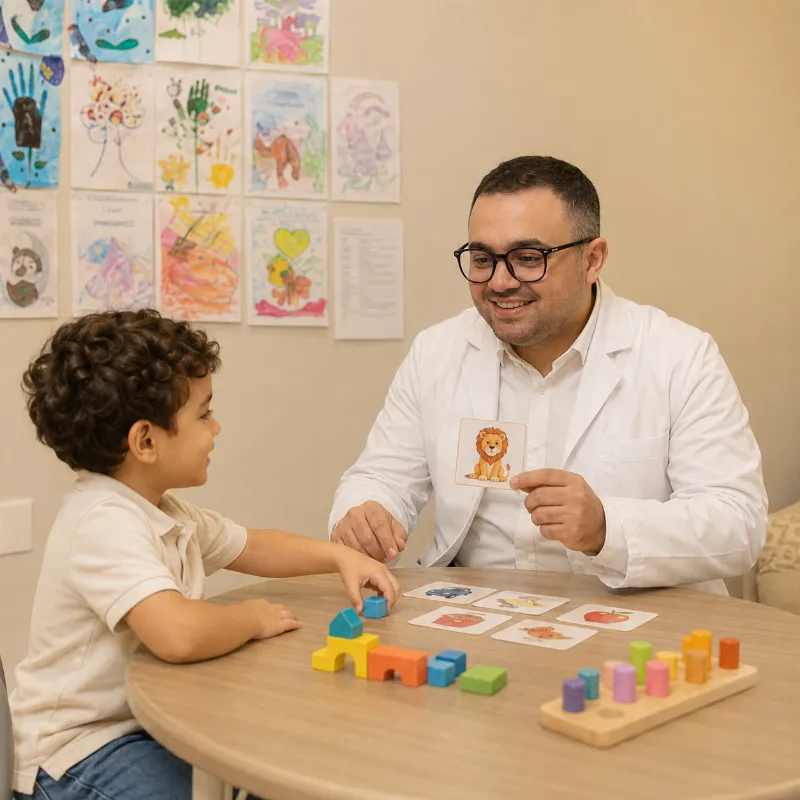
Mostly structured play with a purpose — the therapist creates situations where the target skill is genuinely needed, then supports the child to produce it. Parents are shown the technique so the same opportunities happen at home during the week.
Is my child too young to start?
Rarely. Early communication work happens through play and parent coaching and does not require a child to sit at a table or follow instructions. Waiting for a child to be “old enough to cooperate” usually means waiting too long.
Does a speech delay mean autism?
No. Speech delay has many causes and most children with one are not autistic. Where the picture also involves social communication, play and repetitive behaviour, the team will suggest a specialised assessment rather than guess.
Can this run alongside other therapy?
Yes. Speech commonly runs with ABA and occupational therapy, with the goals coordinated so departments reinforce each other rather than compete for the same session time.
Often combined with
ABA therapy
Where communication and behaviour are tangled together.
Feeding therapy
Shared territory when eating and speech both involve the mouth.
Specialised assessment
The evaluation that sets the starting point.
Conditions we treat
Every presentation and which department handles it.
Reviewed by the Spectra Cure Clinic Egypt speech and language department — Dr. Mai Mohamed Ghazy. Last reviewed July 2026. Spectra Cure Clinic Egypt, 2nd Floor, Building B, Saga Boulevard Complex, Mohamed Naguib Axis, New Cairo 3. Open daily, 10:00 AM to 9:00 PM.
If you are unsure, ask early
An assessment that finds nothing wrong is a good result. Tell the care team what you are hearing at home and they will tell you whether it is worth booking.
Milestones and sound-development ranges on this page are general developmental guides, not diagnostic criteria. Assessment and any therapy plan are decided individually by the treating clinician. In an emergency, call 123 or go to the nearest emergency department immediately.

