
Assessment services in Cairo — and how to tell which one you need
Most families arrive here having noticed something, without knowing what to book. This page is a router. It sets out what each assessment is for, what you are handed at the end, what it cannot answer, and who you would see. If you are still unsure after reading it, tell the care team what you noticed and they will help you choose before you commit to anything.
Book an assessmentAsk the care team first
Start from what you noticed
These are starting points, not diagnoses. One observation often leads to more than one assessment — the diagram below shows why.
One thing you noticed can lead to more than one assessment
A parent says “he doesn’t talk”. That single sentence is consistent with a language disorder, an undetected hearing loss, a global developmental delay, a child who talks freely at home and nowhere else, and a child who is talking but not being understood because of how the sounds are produced. Those are five different assessments with five different clinicians.
This is the reason the first conversation is a triage conversation and not a booking form. The point of it is to decide which door, so that you do not pay for the wrong assessment and then have to start again.
What each assessment actually hands you
The most common disappointment we see is a family who booked one thing expecting the output of another. This table is the honest version. The right-hand column matters as much as the others.
| Assessment | The question it answers | What you leave with | What it does not produce |
|---|---|---|---|
| Consultation | Is this worth assessing, and by whom? | A direction, and an agreed plan for the next step. | A diagnosis, a written report, or scores. |
| Developmental & behavioural assessment | How is my child developing across communication, play, attention, behaviour and daily living? | A written profile, agreed priorities and recommendations, explained to you in person. | A guaranteed diagnostic label, or a prediction of how far your child will get. |
| Psychometric assessment | Where do my child’s abilities sit compared with a norm group? | Standard scores reported as ranges, with an interpretation of the profile rather than the headline number. | A plan on its own. A score describes; it does not tell anyone what to teach tomorrow. |
| Therapy assessment | What can my child do now, and what is the next step in this area? | A baseline, specific goals, and a therapy plan for speech, occupational therapy, feeding, academic support or adapted PE. | A medical diagnosis, or a judgement about areas outside that therapist’s field. |
| Medical review and investigations | Is there a medical contributor that should be treated, or excluded? | Findings, causes ruled in or ruled out, and referrals where they are indicated. | A medical cause for every presentation. Often there is not one, and saying so is a result. |
Why no single test is enough on its own
Every assessment result is produced by a child on a particular day, in a particular room, in a particular language. Seven ordinary things change what that result looks like, and none of them is the thing being assessed.
This is not a reason to distrust assessment. It is the reason a good assessment gathers history, checks the basics and observes, rather than administering one instrument and printing the output.
What this commits us to: we ask for hearing and vision to be checked, or evidenced, before we interpret a language or learning result. A hearing loss corrected early changes the whole picture; a year of therapy without checking it changes very little.
Who does what, and when
An assessment is not a single appointment. Four groups of people are involved and each has a job. Knowing which is yours is the single biggest thing that makes an assessment useful rather than expensive.
An assessment describes today. It does not forecast.
Parents book assessments hoping to be told what happens next. It is the most human thing about this work and the hardest thing to answer honestly. An assessment is an unusually careful description of where a child is now, and of what is getting in the way. It narrows the range of what is likely. It does not fix a point on it.
Development is not a straight line, and the further out you look, the wider the possibilities become. A score obtained at four says a great deal about what to do this term and very little about what a person will be at twenty-two. We will not answer the eighteen-year question, and we would be suspicious of anyone who did.
What we will not do
We will not produce a diagnosis on request.
Not on the day, not to fit a school form, and not because a report is needed by a deadline. A finding written to satisfy a process is worth nothing to the child it is about.
We will not re-test a recently assessed child for a better number.
Repeating a standardised test too soon inflates the score through practice, not progress. If a previous result looks wrong we will say why, and what would actually settle it.
We will not read a screening device as a diagnosis.
Bioresonance or “scanning” devices do not replace a clinical assessment, validated developmental tools, laboratory tests or imaging, and are not used alone to identify toxins, deficiencies, allergies, autism or ADHD.
We will not report a score the instrument cannot support.
Most standardised batteries in international use were normed on children somewhere else, and not tested in Arabic. That does not make them useless. It does mean a single number carries less weight than the report format suggests, and we will name the norms and the test language in the report.
We will not recommend a pathway we would not recommend to a non-paying family.
If triage suggests something smaller would serve you better, you will be told that before you pay for the larger one.
We will not give a prognosis at the first appointment.
Nor at the tenth. See the diagram above.
Every assessment we offer, and where each one leads
This is the full list, grouped by what you are trying to find out. Each line says who it is for, so you can rule things out quickly.
Medical and developmental
- Specialised assessmentThe main developmental and medical assessment pathway — start here if the concern is broad.
- Functional medicine consultationWhen sleep, gut, growth or recurrent illness sit alongside the developmental concern.
- Online consultationA medical opinion delivered from Egypt when travelling in is not practical.
- Functional blood testsOnly when a result would change what is done next.
- Integrated programmeWhen more than one discipline is involved and the plans need to be one plan.
Learning, psychology and school
- Psychometric assessmentStandardised ability and attainment testing, reported as ranges.
- Academic and learning supportReading, writing and number difficulties that persist despite ordinary teaching.
- Child psychologyAnxiety, mood, anger and behaviour that is distressing the child, not only the household.
- School readinessBefore starting school — and it is mostly not about letters and numbers.
- Learning difficultiesBackground reading on what the labels mean.
Therapy assessments
- Speech and languageUnderstanding, talking, and being understood.
- Occupational therapySensory responses, motor skills and everyday independence.
- Feeding therapyA shrinking food list, or mealtimes that have become a fight.
- ABAStructured behavioural teaching, with the method explained.
- Adapted physical educationMovement, coordination and joining in a PE lesson.
- Early interventionThe youngest children, with the parent as the main route.
- Home visitsWhen the goal lives in the house, not in our building.
- Parenting programmeLive-coached, for behaviour that is not shifting with advice alone.
Conditions these assessments speak to
Who you would be seen by
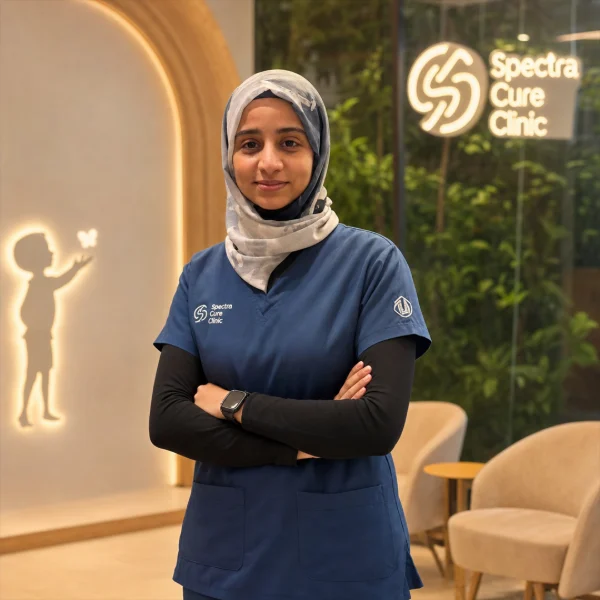
Assessment at Spectra is consultant-led. Which of these people you see is set by the question, not by who has a slot.



Dr. Ehab El Emam
Consultant Paediatrician & Neonatologist · Functional Medicine Practitioner
When an assessment booking is the wrong next step
Seek medical care now, not an assessment appointment
- Skills your child already had have been lost — words, walking, using the toilet, or eye contact that used to be there.
- A seizure, a period of unresponsiveness, or a sudden change in level of consciousness.
- Talk of not wanting to be alive, or any self-harm.
- They have stopped eating or drinking, or there is choking, coughing on fluids, or weight loss.
- A sudden, marked change in behaviour that is out of character and came on over days.
In an emergency in Egypt, call 123 or go to the nearest emergency department. Do not wait for an assessment appointment.
Questions families ask before booking
Which assessment should I book first?
If the concern is broad, or you are not sure, the specialised assessment pathway is the usual starting point because it is designed to sort the question out. If the concern is clearly confined to one area — only speech, only eating, only handwriting — the relevant therapy assessment is a smaller and cheaper first step. If you are unsure, message the care team with what you have noticed and they will tell you which one, before you book.
Will I get a diagnosis at the end?
Sometimes, and sometimes not. Some presentations are clear once the history and observation are put together. Others need information over time, or from school, or a further opinion. An assessment that ends in “here is what we can say, here is what we cannot, and here is how we find out” is a proper result, not a failed one.
How long does it take, and how many visits?
That depends on the pathway and on what the first appointment finds, so we do not publish a fixed number. The care team confirms the arrangements when they schedule you, and will tell you if the plan changes.
Do you accept reports from other clinics?
Yes, and please bring them. A recent standardised test is a reason not to repeat it. Previous reports, school feedback and any hearing or vision results save time and often change what we recommend.
My child was assessed last year. Should we do it again?
Not usually, unless something has changed or the earlier result no longer matches what you are seeing. Repeating a standardised test too soon produces a higher score through practice rather than progress. Bring the old report and we will tell you honestly whether repeating it would tell you anything new.
Are the tests you use standardised for Egyptian children?
For most internationally used batteries, the normative sample was not Egyptian and the testing was not done in Arabic. We use them because they are still the most informative tools available, but we test in the child’s stronger language where the tool allows it, we name the norms and the test language in the report, and we weight the profile and the observation more heavily than the single headline figure.
Can a scan or a device give us the answer faster?
No. Bioresonance and similar screening devices do not replace clinical assessment, validated developmental tools, laboratory tests or imaging, and they are not used on their own to identify toxins, deficiencies, allergies, autism or ADHD. Any device reading is treated as one more piece of context, never as a diagnosis.
Will the report be accepted by my child’s school?
Reports are written to be readable by schools and to translate into classroom recommendations, and we are glad to talk to a school with your consent. What we will not do is write a finding in order to satisfy an admissions or funding process. Whether a particular school accepts a particular report is their decision, not ours.
What should I bring?
Previous medical, developmental and therapy reports; current medicines and supplements; hearing, vision, laboratory or imaging results if you have them; school feedback; and a written list of your own questions. The last one matters more than families expect — appointments run out of time and the questions you came with are the ones that get lost.
Can we do any of this online?
A consultation can be, and it is often a sensible first step if travelling in is difficult. Formal assessment, physical examination, therapy baselines and anything using on-site equipment need the clinic. The online consultation page sets out which is which.
Clinical content on this page reviewed by Dr. Ahmed Ramzy, Consultant Developmental-Behavioural Paediatrician, Spectra Cure Clinic Egypt.
Not sure which one you need? Say what you noticed.
Tell the care team what you have seen and they will point you at the right assessment — including telling you if a smaller one would do.
This page provides general information and is not a diagnosis, a treatment recommendation or a substitute for a consultation. Assessment scope and timing depend on clinical need and service availability. Spectra Cure Clinic Egypt, 2nd Floor, Building B, Saga Boulevard Complex, Mohamed Naguib Axis, New Cairo 3 — open daily 10:00 AM to 9:00 PM.

