
The specialised assessment
One focused session with a specialist, on one track, ending in a written report and a plan you can act on — for families who need to know what they are dealing with before committing to a programme.
An outline of the sections — not a sample result, and not a fixed template that ignores your child.
How far this one goes
The three appointments families confuse are not bigger and smaller versions of each other. They reach different depths and they end in different documents.
A consultation is a conversation that ends in a direction. A specialised assessment is a structured session that ends in a written report and an initial plan. A full diagnostic pathway goes further again, usually across more than one discipline, and is what a formal diagnosis requires. Deeper is not better. It is only better when the question you actually have needs that depth — and the report will tell you plainly if yours does.
Three appointments, three depths, three different documents at the end. This page is the middle one.
Who books this
If several of these apply, one focused session gives you a starting point instead of another opinion.
The concern points one way
What you are seeing sits clearly in one area rather than across several, so a single specialist session can cover it properly.
You need it in writing
A school, a nursery, another clinician or a family member needs a professional evaluation documented, not described.
You are choosing what comes first
Several people have suggested several things and you need someone to say what to start with and why.
You already have a diagnosis
You want to build on it with a current picture and a practical plan rather than re-open the diagnosis itself.
Two tracks — you book one
The assessment is deliberately one track, not a bundle of everything. Picking the wrong one is easy to do from the outside, so tell the care team what you are noticing and let them place you.
Most children show a mix. Tell the care team what you are noticing and they will place you on the starting track — the report then says when the other one is worth doing.
Developmental & behavioural
A specialist evaluation of development and behaviour, supported by a structured behavioural instrument.
- Speech, language or communication is the main worry
- You have autism, ADHD or developmental-delay concerns
- Behaviour at home or at school is the presenting issue
- School readiness, attention or learning is what you need documented
- Specialist evaluation session
- The CBCL (Child Behavior Checklist), a validated parent-report instrument
- Written report with an initial plan

Functional & bio-medical
A specialist medical evaluation of the whole child, supported where indicated by in-clinic screening.
- Recurring physical symptoms are part of the picture
- Feeding, digestion, sleep or energy are the main concerns
- Growth or frequent illness is what prompted you
- A therapy programme has stalled without a clear reason
- Specialist medical evaluation session
- In-clinic screening where clinically indicated
- Written report with an initial plan

A note on screening technology: complementary in-clinic devices support a clinical plan. They are not diagnostic tools, they do not replace validated investigations or standard medical treatment, and no reading from them is presented to a family as a diagnosis. The functional medicine page sets out how they are used.
Breadth costs depth, in the same session
Booking both tracks at once produces a long, tiring appointment and a report that is broad rather than useful. Where both are genuinely needed they are sequenced, usually with the more urgent question first — and that sequence is written into the report rather than sold to you at the desk.
“Everything, skimmed” and “one track, properly” cost the same session.
The two shaded areas are deliberately identical. Spreading one session across five areas does not make it a bigger session — it makes every finding shallower.
How the appointment runs
The care team confirms the booked length when they schedule you, so you can plan the day around it.
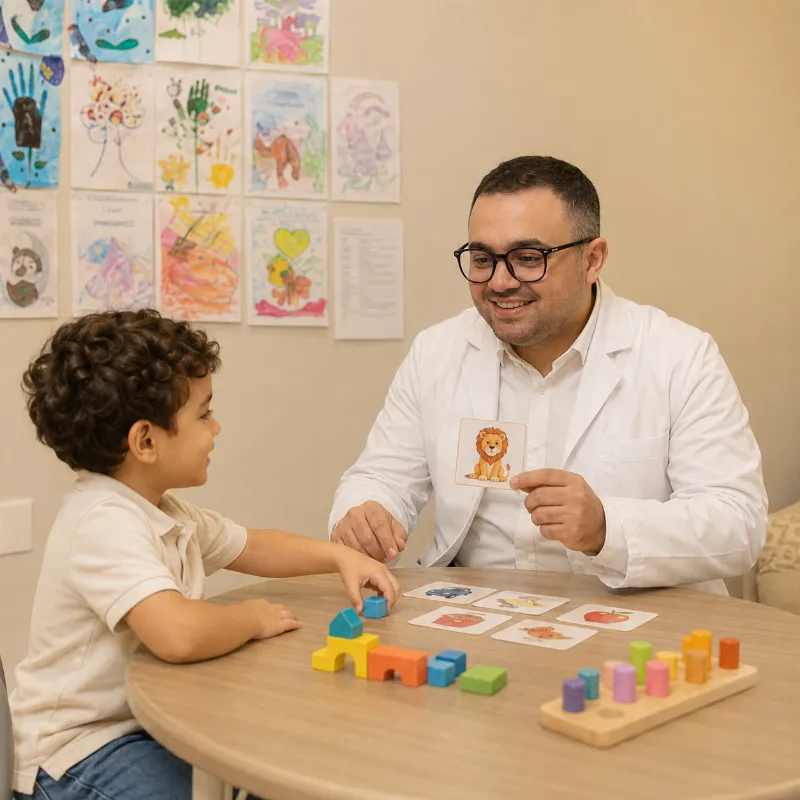
What to bring, and why it changes the session
Send these ahead rather than on the day. A specialist who has read your child’s history before the appointment spends the session on the question rather than on catching up.
- Previous reports and assessments, including any from another clinic
- School or nursery observations, in whatever form you have them
- Laboratory results, if the concern is a physical one
- A current list of medicines and supplements
- A short written note of what worries you most, in your own words
Before you come
Send previous reports, school observations, any earlier assessments and a note of what you are seeing at home. Read in advance, they change what the session can cover.
Talking to you first
The specialist takes the history and the concerns from you directly, including what has already been tried and what happened.
Working with your child
Structured observation and, on the developmental track, the CBCL. On the medical track, examination and any indicated in-clinic screening.
The conversation at the end
What was found, what it means, what it does not mean, and what to do first — explained before you leave, not only written up afterwards.
The written report
Issued with the initial plan. The care team confirms the turnaround when you book and contacts you when it is ready.
What the written report contains
An outline of the sections — not a sample result, and not a fixed template that ignores your child.
Background and concerns
What you reported, what the specialist observed, and the history behind it.
Findings from the session
What was assessed, using which instrument, and what it showed.
Interpretation
What the findings mean, and just as importantly what they do not mean.
Initial plan
What to start with, in what order, and what to review before adding anything else.
What is still open
Anything that needs a further step, a different discipline or more time.
Findings are shared with the therapy departments, so the plan the report sets out is the plan the team actually runs. The report is yours: you can hand it to a school, to another clinician, or to nobody at all.
What an assessment is, and is not
A specialised assessment gives you a professional evaluation, a documented picture and a starting plan. It is not by itself a formal diagnosis of autism, ADHD or a learning disorder — those follow a fuller diagnostic process and sometimes more than one discipline. If that is what your child needs, the report will say so and the team will tell you what it involves rather than sell you a single session.
What we will not do
- We will not hand you a diagnosis on the day because you asked for one. A label that has not been through the right process is worth nothing to the child and can be difficult to undo.
- We will not write a finding into a report to satisfy a school form. If a school needs something the assessment did not establish, the report says what it did establish.
- We will not re-test a child who was assessed recently elsewhere unless a decision genuinely depends on it. Send us what you already have first.
- We will not present a screening-device reading as a diagnosis, or as a measure of how your child’s brain works.
- We will not promise a score, a level or an age equivalent that the instrument cannot support.
- We will not recommend a programme in the report that we would not recommend to a family who was never going to buy it from us.
When repeating an assessment helps, and when it does not
The most common mistake after a first assessment is re-testing too early, usually because progress feels slow and a new number feels like reassurance.
A child who meets the same task a few months later often scores better simply because they have met it before. That is a practice effect, not development. A review of the plan — is it being done, is it working, does it need changing — is almost always the more useful appointment. Re-assessment earns its place when a real decision depends on it: a school placement, a change of programme, or a picture that has clearly shifted.
A score that moves because a child has met the task before has not told you anything about the child.
Questions parents ask
How is this different from a normal consultation?
A consultation is a conversation that ends in a direction. An assessment is a structured evaluation session that ends in a written report and an initial plan — it takes longer, uses instruments where relevant, and produces a document you can give to a school or another clinician.
Which track should we book?
Tell the care team what you are noticing in a couple of sentences and they will place you. If the picture spans both, they will say which one to start with and why — and it is normal for the report to recommend the other track afterwards.
Can we do both tracks?
Not in one session, deliberately. Doing both at once produces a long tiring appointment and a report that is broad rather than useful. Where both are needed they are sequenced, usually with the more urgent question first.
Does this give us an official diagnosis?
Not on its own. It gives you a professional evaluation, a documented picture and a plan. A formal diagnosis of autism, ADHD or a learning disorder follows a fuller process; the report will state clearly whether that is the recommended next step.
Will the school accept the report?
It is a written specialist report on clinic letterhead setting out findings and recommendations, which is what schools normally ask for. If your school has a specific form or requirement, send it to the care team before the appointment.
What is the CBCL?
The Child Behavior Checklist is a widely used, validated parent-report questionnaire covering emotional and behavioural functioning. It is scored and interpreted by the specialist alongside the session — it is one input into the picture, not a verdict on its own.
What age is it for?
Children and adolescents, which is most of who we see. The instrument and the approach are matched to the child’s age; tell the care team how old your child is when you book.
What should we bring?
Previous reports and assessments, school or nursery observations, any laboratory results, a list of current medicines and supplements, and a short written note of what concerns you most. Send them ahead rather than on the day.
Should we repeat the assessment later?
Only when a decision depends on it — a school placement, a change of programme, or a picture that has clearly shifted. Repeating a test too soon mostly measures familiarity with the task. A review of the plan is usually the more useful appointment.
What happens after the report?
You are under no obligation to start anything here. If a programme is recommended the report says what and why; many families take the report away, and some come back months later. That is a reasonable way to use it.
What usually follows
Medically reviewed by the Spectra Cure Clinic Egypt clinical team — Dr. Ahmed Ramzy and Dr. Mohamed Afify. Last reviewed July 2026. Spectra Cure Clinic Egypt, 2nd Floor, Building B, Saga Boulevard Complex, Mohamed Naguib Axis, New Cairo 3. Open daily, 10:00 AM to 9:00 PM.
Understand the picture before choosing a plan
Tell the care team what you are noticing. They will confirm which track fits, what to bring, and what you will walk out with.
Medical information on this page is general and is not a diagnosis or a personal treatment recommendation. Suitability and the appropriate track are decided individually by the treating clinician. In an emergency, call 123 or go to the nearest emergency department immediately.

