
OligoScan screening in New Cairo
OligoScan is a small optical instrument. A light source is held against four points on the palm, the device records how much of that light comes back, and software turns those readings into an indicative profile of around twenty minerals, trace elements and heavy metals.
The measurement takes about two minutes. Nothing enters the body, there is no needle, and there is no radiation. This page is mostly about the part nobody explains: how far a reading like this can actually carry you, and where a laboratory test has to take over.
1 · THE MEASUREMENT
What the machine actually does
The device head contains light sources at several wavelengths and a sensor. Held against the palm, it emits light, some of that light is absorbed by the tissue just under the skin, and the sensor records how much returns. That absorbance figure is the only thing the instrument physically measures.
Everything printed on the report after that point is produced by the manufacturer’s software: a calculation that converts absorbance into an estimated level, and a rule that places that estimate in a low, adequate or high band. The light does not reach organs, bone or blood vessels of any depth — it reaches the first few millimetres of tissue in one hand.
2 · THE LIMIT
How far one reading can carry you
This is the single most useful thing to understand before you book. Each step below is a real claim someone might make about the same reading, and they are not equally supported. The first three describe what happened inside the machine. The rest are conclusions about you.
A doctor may reasonably use a flagged reading as a prompt — a reason to ask a question, take a fuller history, or order a test. What nobody can do with it is name a deficiency, explain a symptom, or justify a treatment.
How far a single OligoScan reading can carry you
What it looks at — and what it does not
The instrument returns an indicative profile in three groups: bulk and trace minerals, a small set of heavy metals, and a general oxidative-stress index. That is the honest scope.
You will find longer lists advertised for devices like this — fatty-acid panels, environmental-toxin panels, hundreds of biomarkers. They are not real. No instrument of this kind detects glyphosate, BPA, phthalates, PCBs, pesticide residues or parabens from a hand, and none of them measures omega-3 or omega-6 status. Everything below is a claim we will not make.
The device does return a vitamin-related index. We do not present it as a measured vitamin level, because it is not one, and a vitamin D result that matters clinically is a blood test that costs very little and answers the question properly.
3 · WHERE A MINERAL ACTUALLY IS
Why a palm reading and a blood test are not interchangeable
Parents often ask which one is "better". They are not competing versions of the same thing — they look in different places. A mineral sits in several compartments of the body at once, and a test only sees the compartment it samples.
This is also why you cannot use one to overrule the other. A normal blood result does not prove a tissue estimate wrong, and a flagged tissue estimate does not prove a blood result wrong. Only one of the two, though, has decades of laboratory standardisation behind it.
The same mineral sits in four different places
How to read the report you are handed
The report is a list of elements, each with a coloured bar and a marker somewhere along it. It looks like a laboratory result and it is worth knowing exactly how it differs from one.
There is no unit anywhere on it, so there is no number you can carry to another clinic or compare against a reference range. The band edges are set inside the manufacturer’s software rather than by a clinical guideline. And the whole thing describes one hand at one moment.
What one row of an OligoScan report actually says
2 · THE LIMIT
Where the evidence stands
We would rather you read this here than find it elsewhere afterwards. Devices of this type — optical tissue-mineral analysers — do not have published, peer-reviewed studies establishing that their readings agree with reference laboratory methods such as blood or urine analysis. The same is true of the other screening devices we run, including the Physiospect scan. They are not recognised by medicines regulators as diagnostic instruments, and no professional body recommends them for diagnosing mineral deficiency or metal toxicity.
That is not the same as saying the appointment has no value. It is a comfortable, non-invasive few minutes that gives a doctor something concrete to talk around, and in practice most of the value of the visit is the unhurried conversation and the history that gets taken alongside it. What we will not do is let the printout do work it cannot do.
If you want a functional-medicine consultation with proper laboratory work behind it, that is a different and better-supported appointment, and we would rather book you into that one.
5 · AFTER THE PRINTOUT
Two ways this appointment can go
The difference between a useful screening appointment and a wasted one is not the device. It is what happens in the twenty minutes after the printout. If you are not sure which appointment answers your question, the assessment hub walks through the options.
Two ways an OligoScan appointment can go
The rules we apply
- A reading is read by a doctor, next to the history and the examination — never on its own, and never by the person who sold the appointment.
- Anything that would change your plan goes to a laboratory before it changes anything.
- If the history suggests a real exposure, we order the test that answers it rather than another scan.
- Nothing is sold to you at the end of the appointment. No supplements, no protocol, no package.
- If a smaller or different appointment would serve you better, we say so before you pay for this one.
- If a child does not want it, we do not do it. It is a light on the palm, and it is not worth a struggle.
What we will not do
- Give a diagnosis from a device reading.
- Sell a supplement, chelation or "detox" protocol off a coloured band.
- Claim it can find a parasite, a virus, a food intolerance, a pesticide or a plastic.
- Repeat the scan "to track progress" — the reading is not precise enough for a change between two of them to mean anything.
- Use it in place of a laboratory test your child actually needs.
- Print a number the instrument cannot support.
If you think there has been a real exposure
Suspected poisoning is a medical emergency, not a screening question. If a child has swallowed something, or you have a specific reason to suspect a significant lead or mercury exposure, do not wait for an appointment of any kind — go to an emergency department, and in Egypt the ambulance number is 123. Bring the container or the substance with you if you can.
Who runs it, and who reads it
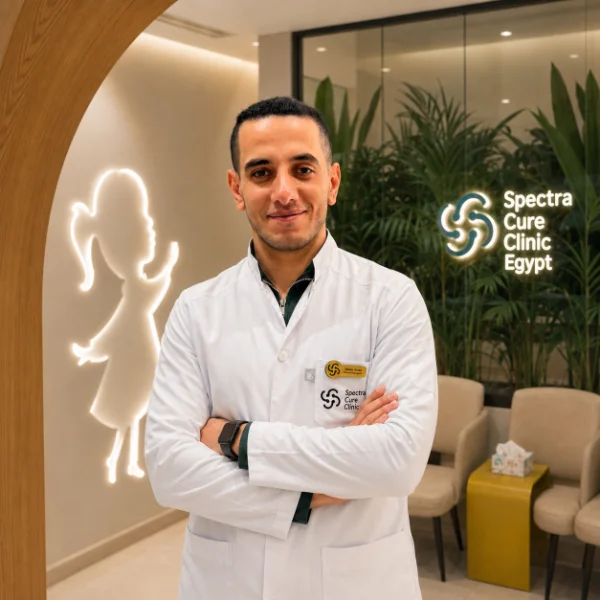
The scan itself is run by our laboratory doctor, deliberately: the person who takes the reading is the same person who can tell you what a laboratory would have to do to confirm it. Device use across the clinic is supervised by our paediatric consultant, and anything with a medical consequence goes to the consultant who ordered it.


Questions people ask
Is OligoScan a blood test?
No. Nothing is drawn and nothing is sent to a laboratory. It is an optical reading taken through the skin of the palm, and its output is an indication rather than a measured concentration.
How does the device actually work?
It shines light at several wavelengths onto four points on the palm and measures how much of that light returns. Software converts the absorbance into an estimated level for each element and places it in a low, adequate or high band. It is spectrophotometry, not bioresonance and not a "frequency" or "quantum" method.
Does it hurt? Is it safe for a child?
It is painless. The hand rests on the device for a couple of minutes, nothing enters the body, there is no needle and there is no radiation. The only requirement is sitting reasonably still, and if a child does not want to, we do not insist.
Can it detect heavy-metal poisoning?
No, and this is the most important answer on the page. It can flag a heavy metal as high, which is a reason to ask questions. Confirming or excluding an actual exposure needs a laboratory test — a blood lead level or a urine analysis — and that is what we order when the history warrants it.
Does it measure vitamins?
It returns a vitamin-related index. We do not report that as a vitamin level, because it is not one. If a vitamin D or B12 level matters for your plan, we ask for the blood test, which is inexpensive and definitive.
Can it find parasites, viruses or food intolerances?
No. No device of this kind can, and we will not say otherwise. Those questions have their own tests and their own clinical routes.
Will I be given supplements based on the result?
No. We do not sell a supplement plan, a chelation course or a "detox" protocol off a coloured band, and nothing is sold to you at the end of the appointment. If a supplement is genuinely indicated, that decision is made by a doctor on the basis of history, examination and — where it matters — laboratory results.
How long does it take, and when do I get the report?
The measurement itself takes about two minutes. The appointment around it is longer, because the useful part is the conversation. The care team confirms the appointment length and when the written report reaches you at the time they book you.
How strong is the evidence for this device?
Limited. There are no published peer-reviewed studies establishing that readings from this class of instrument agree with reference laboratory methods, and it is not recognised by regulators as a diagnostic device. We say so on the page rather than leaving you to find out afterwards.
Should I do this or a blood test?
If you have a specific clinical question — a suspected deficiency, a suspected exposure, a symptom that needs explaining — the blood or urine test is the answer, and we will order it. This scan is a broad, non-invasive look that can start a conversation. If you tell the care team what you are actually worried about, they will tell you which of the two you need before you pay for either.
Medically reviewed by Dr. Mohamed Afify, Consultant in Functional and Bio-Medical Medicine, Spectra Cure Clinic Egypt. Last reviewed 31 July 2026. This page is general information about a screening device. It is not a diagnosis and it is not a substitute for a consultation.
Tell us what you are worried about first
You do not have to decide between appointments on your own. Tell the care team what prompted the question and they will tell you whether this screening, a functional-medicine consultation or a laboratory panel is the right first step. Spectra Cure Clinics, New Cairo. Open daily, 10:00 AM to 9:00 PM.

