Photobiomodulation: red and near-infrared light therapy in New Cairo
Photobiomodulation (PBM) uses low-power red and near-infrared light to influence how cells behave. At Spectra Cure Clinics Egypt it is a doctor-prescribed adjunct inside a wider plan — never a stand-alone treatment, and never offered as a therapy for autism, ADHD or developmental delay.
What photobiomodulation actually is
PBM is the old “low-level laser therapy” and “cold laser” under a newer, more accurate name. The change of name matters: the effect being studied is a signalling effect, not a heating one.
How far into the body light actually gets
This is the single most useful thing to understand before anyone quotes a wavelength at you. Depth is decided by the colour of the light and by the tissue in front of it — not by how long the session runs, and not by turning the machine up.
Why this page names no wavelengths, no session length and no device brand
An earlier version of this page listed exact wavelengths, an exact magnetic field strength and an exact session length, and named a device brand. We removed all of it, because the honest position is this: the equipment in use, the settings and the length of a session are clinical decisions taken by the treating doctor for one patient, and they are not fixed properties of a page on a website. When you book, the care team will tell you exactly which device is used, how long your appointment is, and what it is being used for. If anyone quotes you a specification instead of a reason, ask them for the reason.
More is not better. That is not caution — it is how the effect works.
Photobiomodulation has a biphasic dose response. Below a certain dose nothing measurable happens. Above it, the effect appears. Push further and the effect does not keep growing — it flattens and then reverses. This is one of the most consistent findings in the whole PBM literature, and it has a direct commercial consequence: a longer session, a higher setting or an extra weekly visit is not automatically worth more to you.
What this commits us to
- We do not sell PBM by the package before a doctor has said it is indicated.
- We do not add sessions because a family asks for faster results. If a course is not working, the answer is to reconsider, not to double it.
- We do not run a session “since you are already here”.
- If a home device would achieve the same thing for you more cheaply, we will say so.
Where the research is strong, where it is mixed, and where there is none
“Photobiomodulation is evidence-based” is a sentence that hides everything useful. Evidence exists for a particular problem, at a particular dose — and it does not transfer to a different problem just because the same lamp is used.
| Used for | What the research looks like | Do we offer it for this? |
|---|---|---|
| Mouth ulceration during cancer treatment | The strongest evidence PBM has. It appears in international supportive-care guidance for cancer patients. | No — not our field. This is hospital oncology care and we would refer, not treat. |
| Musculoskeletal pain and soft-tissue injury | Mixed to moderate. Several trials are positive, several are not, and the difference between them is very often the dose rather than the machine. | Sometimes — as an adjunct, when a doctor here has examined the problem and named it. |
| Wound and soft-tissue healing | Supportive but highly variable between studies. Promising rather than proven. | Sometimes, alongside — never instead of — proper wound care. |
| Skin appearance, anti-ageing and hair growth | Device-specific. Some products carry regulatory clearance for adult cosmetic use; that clearance belongs to the product, not to “light therapy” in general. | No. We are a paediatric developmental and functional-medicine clinic. We do not run aesthetic or hair programmes. |
| Autism, ADHD, developmental delay, speech delay, “brain function” | Not established. Light applied to the head is an experimental research area with small, early studies. There is no basis for offering it as a treatment for a developmental condition. | No — and we will decline if asked. The therapies with real evidence for these conditions are listed further down this page. |
| “Detox”, immunity, energy, general wellness | No accepted evidence, and the claims themselves are not clinically defined, so there is nothing to measure. | No. |
Most families reach this page from an autism, ADHD or speech-delay search. Please read this part.
Light therapy is not a treatment for a developmental condition, and no one at Spectra will offer it to you as one. If that is what brought you here, the honest recommendation is a proper assessment first, and then the therapies that do have evidence behind them — speech and language therapy, applied behaviour analysis, occupational therapy, early intervention. Those are on this site, and they are what we would want for our own children.
Devices are the easiest thing in this field to sell and the hardest thing to justify. We would rather lose the booking than take money for a session that cannot do what a family is hoping it will do.
Who should not have a session, and what the doctor must know first
“Non-invasive” is not the same as “no precautions”. Bring your child’s current medicines with you, including anything bought without a prescription.
We will not treat
These are absolute in our clinic. Asking will not change the answer.
- Over a known or suspected tumour, or over an area being treated for cancer
- Anywhere the beam could enter the eye — the eyes are never a target
- Over the abdomen or lower back in pregnancy
- Over an area that is actively bleeding, or a suspected fracture that has not been imaged
- A child who cannot reliably keep eye protection on for the whole session
- As a replacement for a medicine, therapy or investigation the child actually needs
Tell the doctor before booking
None of these automatically rules a session out. All of them change the decision.
- Any medicine or supplement that increases sensitivity to light — certain acne treatments, some antibiotics, some psychiatric medicines, St John’s wort
- A diagnosed photosensitivity disorder, or skin that reacts badly to sun
- Epilepsy, or any history of seizures triggered by flashing light
- Thyroid disease, if the neck is anywhere near the treatment area
- A pacemaker, cochlear implant, programmable shunt or any implanted electronic device — this matters for units that add a magnetic field
- A steroid injection into the same area in recent weeks
- Fever, or an untreated infection
- Tattoos or very dark pigment over the target area — they absorb more light and warm up faster
Usually not a problem
Common worries that do not, on their own, stop a session.
- Ordinary daily medicines with no light-sensitivity warning
- Having eaten normally beforehand
- A therapy session — speech, occupational therapy, ABA — on the same day
- Physiotherapy or exercise before or after
- Being a child, provided eye protection is worn and the child is comfortable
This page is not the place for anything urgent
Severe or sudden pain, a head injury, a limb that cannot bear weight, a fever with a rash, a seizure, difficulty breathing, or a child who has lost skills they previously had — none of these is a light-therapy question. Go to an emergency department, or call 123 in Egypt.
A short course with a review built in — not an open-ended subscription
PBM effects, where they exist, tend to accumulate across a small number of sessions and then plateau. So a course is planned with a point at which somebody has to answer the question “is anything measurably different?” — and a rule for what happens if the answer is no.
Consultation first
PBM is not bookable on its own. A doctor examines the problem, takes a history and decides whether light has any part to play in it.
A named target
If it is indicated, the record says what is being treated and what would count as a change. “General wellness” is not a target.
The session
Eye protection on, the area exposed, the emitter positioned. You feel warmth at most. Length and settings are set by the doctor, not by request.
The review
At the review point we compare against the target that was written down. If it has not moved, the course stops and we look at the problem again.
The doctors who prescribe it here
Photobiomodulation sits inside the clinic’s functional-medicine and biomedical track. It is prescribed by a doctor who has seen the patient, and it is recorded in the same plan as everything else.
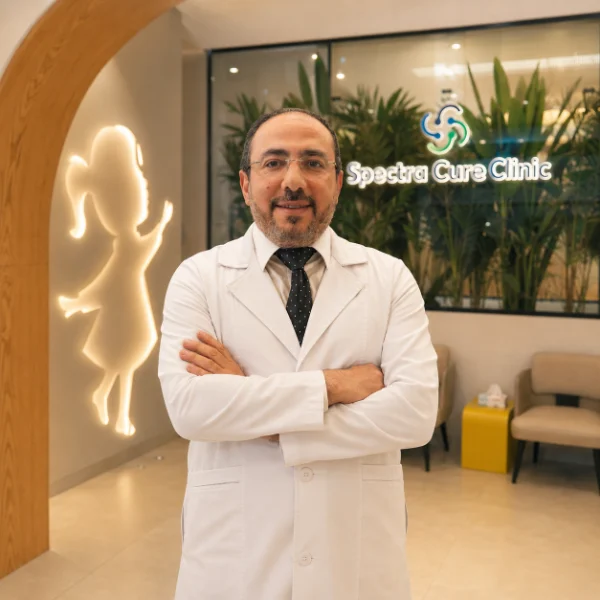
Dr. Mohamed Afify Ali
Paediatrician · Functional Neurology SpecialistSees children on the functional and biomedical track, and decides where a device does or does not belong in a plan.
Read his profile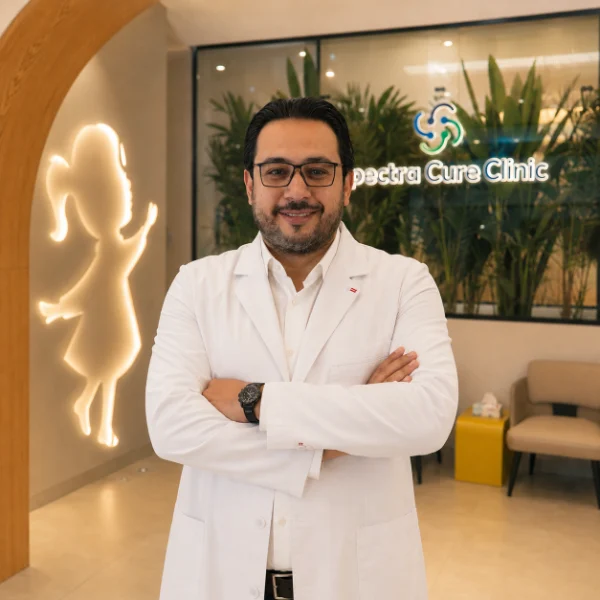
Dr. Ehab El Emam
Consultant Paediatrician & Neonatologist · Functional Medicine PractitionerCarries the follow-up on the functional-medicine track, including reviewing whether an adjunct is still earning its place.
Read his profilePhotobiomodulation: the questions we get
Will it help my child’s autism, ADHD or speech delay?
Does it hurt?
How long is a session and how many will we need?
Is it safe for children?
Do I need a consultation first, or can I just book a session?
Is there any downtime?
Can it be used at the same time as speech therapy, ABA or occupational therapy?
What if we finish a course and nothing has changed?
Should we buy a red-light device for home?
Where is the clinic, and when is it open?
What we would look at before, or instead of, a device
If you arrived here looking for something to help a child, one of these is almost certainly a better first step.
Ask a doctor whether this belongs in your plan
Book a consultation at Spectra Cure Clinics Egypt in New Cairo. If photobiomodulation is not the right tool for your child, we will tell you that at the consultation rather than after a course of sessions.
Photobiomodulation is a supportive technology used alongside medical and developmental care. It is not a cure, not a diagnosis and not a substitute for treatment. Suitability, session length and the number of sessions differ from person to person and are decided by the treating doctor after an examination. This page is for information only and does not replace a medical consultation. In an emergency in Egypt, call 123.

