
Assessment technology · Spectra Cure Clinics Egypt
Physiospect Scan in New Cairo
Physiospect is a non-invasive scan that produces a colour-coded picture of the body on a screen. This page explains plainly what that picture is, what it is not, and the rules our doctors apply before it changes anything in your child’s plan.
The instrument
What the machine actually does
A headset holding sensors is placed on your child’s head. The device works with very low-level electrical signals. Nothing is injected, no sample is taken, there is no radiation and there is no scanner tunnel or noise.
The software then compares what it records against a library of stored reference patterns, and draws a picture from the result of that comparison.
That last step is the one worth understanding, because it is the step families are almost never told about. The colours on the screen are produced by a software comparison. They are not a measurement of an organ. Everything to the left of the dashed line below is a physical signal. Everything to the right of it is a model, and then a judgement — and the judgement is a doctor’s, not the machine’s.
The appointment
What it looks like in the room
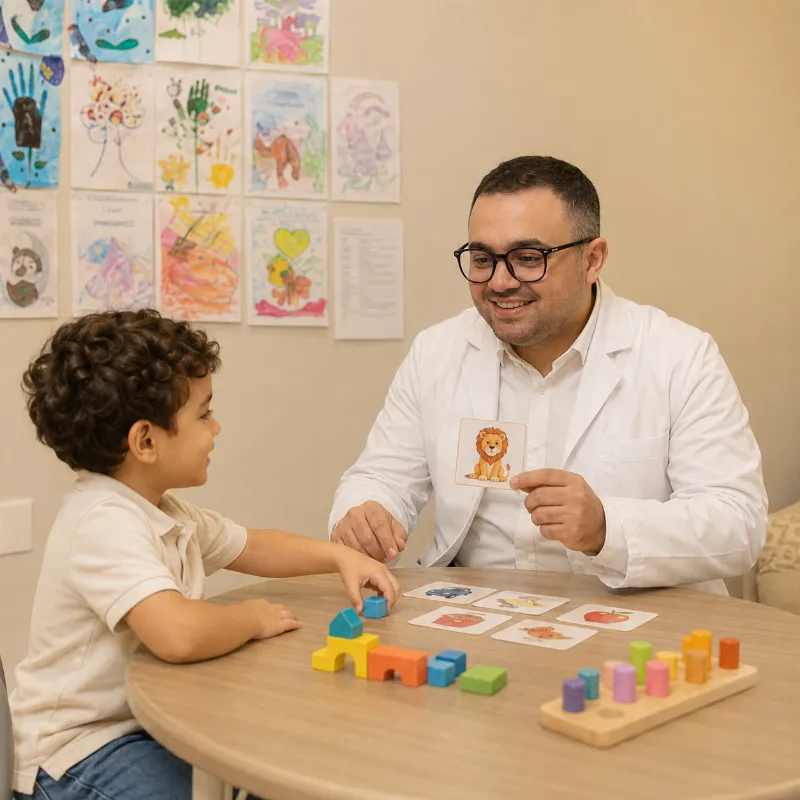
There is very little to it, and that is the point. Your child sits down, a light headset is placed on their head, and they stay reasonably still while the screen fills. A parent stays in the room throughout.
Nothing has to be done beforehand
There is no fasting and no preparation. If your child is unwell on the day, we would rather reschedule than have them sit through it uncomfortably.
The care team confirms the length when they book you
We do not publish a fixed duration on this page because appointment lengths are set by the clinic when the slot is booked, and we would rather not print a number we cannot promise.
A child who does not want it does not have to have it
Some children dislike anything on their head. That is a good enough reason to skip it. Nothing in a Spectra plan depends on this scan existing.
The reading is recorded as a device reading
If it appears in your child’s notes it is labelled as a device reading, with the date. It is never written up as a diagnosis, and it never appears as one in a report.
The output
The picture it produces, decoded
What comes out is a diagram of the body with regions shaded on a scale. It looks like a result, which is exactly why it needs explaining.
The scale has no units. It is not milligrams, not millilitres, not a percentage of anything, and not a count. It is an index the software produces by comparing patterns. Two children’s maps cannot be compared with each other, and the same child’s map on two different days can differ without a single thing in the child having changed.
So the honest reading of a shaded region is this: the software’s comparison placed this region further from its stored reference pattern. That is the whole of what it says. What it means — if it means anything — is a question, not an answer.
The honest version
What actually answers the question
Below are the seven things families most often hope a scan will settle. The middle column is what this scan can contribute to each one. We have not softened it.
| What you want to know | What this scan can contribute | What actually answers it |
|---|---|---|
| Is my child’s hearing part of the speech delay? | Nothing | A proper audiology assessment |
| Is my child low in iron, vitamin D or B12? | Nothing | A blood test through the laboratory |
| Does my child have a food allergy or coeliac disease? | Nothing | Validated allergy testing or coeliac serology, ordered by a doctor |
| Is this autism, ADHD, or something else? | Nothing | A structured developmental and behavioural assessment |
| Could there be seizures? | Nothing | An EEG, read by a paediatric neurologist |
| Is there something structural we need to see? | Nothing | Imaging requested by a doctor |
| Is there anything we have not thought to look at? | It can raise a question the doctor may decide to follow up properly | Whichever validated test the doctor then chooses |
Six of the seven answers in the middle column are nothing. We would rather you read that here than discover it after paying for the wrong appointment.
The one rule that matters
It can open a question. It cannot close one.
Almost every misunderstanding about this scan comes from one asymmetry. A shaded region is allowed to make a doctor curious. It is never allowed to conclude anything — and, just as importantly, a map that looks unremarkable is never allowed to end an investigation.
Where the evidence stands
What “it showed something” can mean
Any test that flags things can be wrong in two directions. It can flag something when there is nothing there, which costs a family worry, further tests and money. It can stay quiet when there is something there, which is worse, because it sends everyone home reassured.
For validated medical tests, those two error rates have been measured, published and argued over, and doctors use the numbers when they decide what a result is worth. For bioresonance-type scanners, including this one, that work has not been done. There is no body of peer-reviewed evidence establishing how often a Physiospect reading is right or wrong, and it is not recognised as a diagnostic instrument by medical regulators.
We put that on the page rather than leaving you to find it, because the alternative — presenting a colour map as though it carried the weight of a laboratory result — is the thing that actually harms families.
It does not follow that the appointment is worthless. It follows that it is worth what a comfortable, non-invasive look and an unhurried conversation with a doctor is worth. That is not nothing. It is also not a diagnosis, and we will not let it be sold to you as one.
How we handle it
The rules we apply to every device reading
It is never the reason for a diagnosis
A diagnosis at Spectra comes from history, examination, structured assessment and validated testing. A device reading is not one of those things and does not become one by being on the screen.
It is never the reason to start a treatment on its own
No supplement, protocol, diet or device programme is started because of a colour on a map. If a treatment is proposed, ask us what it rests on — the answer should never be this scan.
It is never read on its own
It is looked at next to what you have told us, what the doctor found on examination and what other testing has already shown. Read in isolation it means nothing at all.
Anything it raises is either followed up properly or dropped
If a question is worth having, it is worth answering with a test that can answer it. If it is not worth a real test, it was not a real question.
A quiet map never ends an investigation
If your child’s symptoms warrant looking further, we look further, regardless of how the map looked.
If a validated test answers your question, we book that instead
Even when it is the cheaper appointment, and even when it means you do not book this one.
What we will not do
- We will not give you a diagnosis from a device reading.
- We will not sell you a supplement, a protocol or a device programme off the back of a colour on a screen.
- We will not tell you the scan has found a parasite, a virus, a heavy metal or a food intolerance. It cannot, and claims of that kind made for bioresonance devices are not supported by evidence.
- We will not repeat it to “track progress”, because there is nothing validated to track.
- We will not use it in place of a test your child actually needs.
- We will not put a child through it who does not want anything placed on their head.
Who is involved
The people who read it, and the people who answer the question

Dr. Mai Mohamed Ghazy
Pediatric Consultant · supervises the clinic’s assessment devices
MBBCh Tanta University, Master’s in Paediatrics and an MD on delayed speech from Al-Azhar University. She oversees how the assessment devices are used at Spectra Cure Clinics Egypt and where their output is allowed to sit in a plan.
Full profile
Dr. Mohamed Afify
Consultant Pediatrician · Functional Neurologist
More than 20 years of clinical practice across Egypt, the UAE and Europe. He sets the medical direction for functional medicine at Spectra Cure Clinics Egypt, and any device reading is weighed against the clinical picture before it changes anything.
Full profile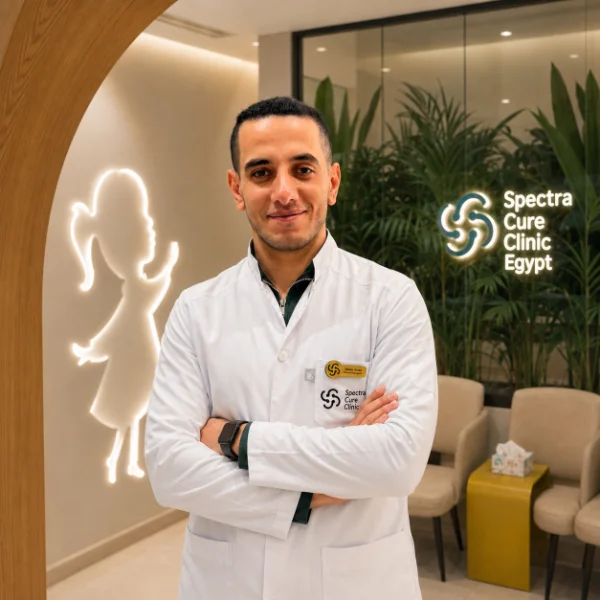
Ahmed Zaki
Laboratory Doctor · Medical Laboratory Specialist
Responsible for laboratory investigation and the accuracy of the results the medical team relies on. When a question needs a real answer rather than an overview, it goes through the laboratory — not through a device.
Full profileQuestions families ask
Physiospect: your questions
Is a Physiospect scan safe for a child?
Yes. Nothing is injected, no sample is taken, there is no radiation and there is no enclosed scanner. A light headset is placed on the head and the child sits still. The only real barriers are a child who dislikes having something on their head, or a child who cannot stay still — and neither is a problem, because the scan is optional.
Will it tell me what is wrong with my child?
No. It does not diagnose anything and it does not rule anything out. It produces a colour-coded overview that a doctor may use as one small input alongside history, examination and validated testing. If you need an answer to a specific question, the answer will come from a test built to answer it.
Does it detect parasites, viruses, heavy metals or food intolerances?
No. Those claims are made for bioresonance devices in general and they are not supported by evidence. We will not make them here and we will not act on them. Suspected allergy, coeliac disease, nutrient deficiency or infection are investigated with validated laboratory testing ordered by a doctor.
Then why do you offer it at all?
Because it is comfortable, non-invasive and some families find a visual overview a useful way into a longer conversation with a doctor. That is the honest reason. The value in the appointment is the doctor’s time and attention, and we would rather say so than dress the device up as something it is not.
Does my child need to fast or prepare?
No. There is no fasting and no preparation. The care team confirms the appointment length when they book your slot.
How often should it be repeated?
It should not be repeated to track progress. There is nothing validated to track, so a second reading cannot tell you whether anything has improved. Progress in a Spectra plan is tracked against the goals in the plan itself.
Will the result appear in a report?
If it appears at all it appears as a device reading, labelled as such, with the date. It is never written as a diagnosis and it is never presented as a finding that stands on its own.
Can I take the result to another doctor?
You can, but be prepared for them not to accept it — and they would be right not to. It is not a recognised diagnostic instrument. If you need something another clinician can act on, ask us for the validated test instead and we will arrange it.
Is it covered by insurance?
There is no direct insurance billing at Spectra Cure Clinics Egypt. You are given an invoice and, where relevant, a stamped report that you can submit to your insurer yourself. Whether they reimburse it is their decision.
What should we book instead if we want an answer?
It depends on the question. A specialised assessment for a developmental picture, psychometry for cognitive and learning questions, functional blood tests for nutritional and metabolic questions, or a functional medicine consultation if you are not sure where to start. If you tell the care team what you are worried about, they will point you at the right one.
Where to go next
The appointments that answer questions
Other assessment technology at the clinic
Every one of these carries the same rule: a device reading supports a doctor’s thinking, and never replaces it. Neurofeedback and IV therapy are offered at our Dubai clinic only and are not available in Egypt.
Medically reviewed by Dr. Mohamed Afify, Consultant Pediatrician and Functional Neurologist, Spectra Cure Clinics Egypt. Last reviewed 31 July 2026.
Not sure whether this is the right appointment?
Tell the care team what you are actually worried about. If a scan is not the thing that will answer it, they will say so and point you somewhere better.
Open daily · 10:00 AM – 9:00 PM · New Cairo · Spectra Cure Clinics Egypt

